I have changed the second era from 1919 to 1960 because between the Wars is a short period given that the Second World War was also included. It effectively meant the period was only 20 years. I have therefore extended the period to 1960 as the post-war era produced some outstand players.
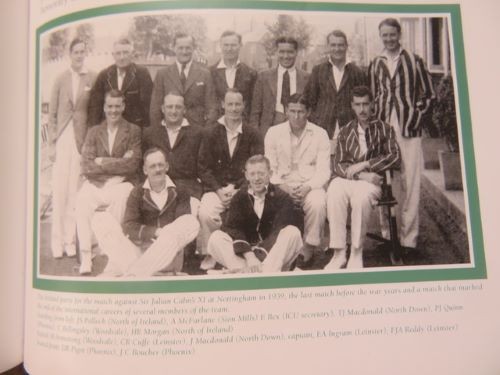
Sadly, the Second World War ended the career of some of the Greats including North Down’s James and Tom Macdonald, Willie Andrews, Armagh’s Bobby and Jackie Barnes, and North’s Harry Morgan. However, it now includes some of the Great teams in the Fifties like Sion Mills, Donemana, Woodvale and Lisburn.
The period also includes some of the Great Captains like Eglinton’s AH ‘Doc’ Montgomery, Sion Mills Paddy Gallagher, Donemana’s Alex McBrine, Brigade’s Willie Garvey, Lisburn’s Cecil Walker, Woodvale’s Billy McCleery and the inimitable Willie Andrews. He was North Down Captain 39 times!
I will always be indebted to Donald Shearer for his opinions. He played for City of Derry for a decade between the War and North of Ireland in the post-war era. The Belfast and Dublin hierarchy gave scant respect for North-West cricket for over forty years, but Shearer changed it. He was the first North-West player to win an Irish cap in 1932, and spoke highly of others in the North-West like Andy McFarlane, Paddy Gallagher, Bobby Taylor and Paddy McLaughin. Andy was the first local North-West player to be capped in 1934. Of course, the War denied caps, although the post-war gave their opportunities to the likes of Scott Huey, John Flood, Aubrey Finlay, Brendan Donaghy, Ossie Colhoun et al.
In my selection there are automatics-James Macdonald, Donald Shearer, Stuart Pollock, Andy McFarlane, Scott Huey, John Flood, Ray Hunter, and a toss-up between wicket-keeper Jack Dearden and George Crothers. I opted for Crothers because his batting was better! I also included Tom Macdonald to strengthen the batting. That meant I omitted Authur Douglas, Bobby Taylor, Bobby Barners, Paddy McLaughin, Jim Ranlin, Sam Edgar, Jimmy McKelvey, Larry Warke, George Wilson, Billy McCleery, Tom McCloy, Herbie Martin and Jack Bowden. There could be others!
The slow bowlers are well catered for with Macdonald, Huey, Flood and McFarlane, although I omitted Brigade’s Willie McGarvey, and post-war North’s Sonny Hool, Archie McQuilkin and Frank Fee. The biggest problem I incurred were fast bowlers. I have opted for Charlie Billingsley and Harry Arrmstrong as they captured hundreds of wickets in tandem for Woodvale and 12th man Lisburn’s Tommy Martin for his hostile and aggressive action. Of course, Ray Hunter was also a fine opener in his heyday. Unfortunately, I have omitted Bobby Baird, Harry Morgan and Jack Flemming between the wars and post-war Jack Stanley Hewitt, Noel Ferguson and Wesley Ferris.
JAMES MACDONALD (Captain)
The complete all-rounder-brilliant batsman, slow bowler and excellent fielder. A dual international of cricket and hockey who captained both but never at North Down as Willie Andrews ruled supreme. Macdonald’s records at NCU in cup and leagues were awesome and although he only scored one century for Ireland, he scored seven fifties. Unfortunately, he missed 18 matches due to work and ill health. There is a good argument that he was the greatest Ireland all-rounder of all time.
STUART POLLOCK
In his book “Ireland 100 Cricket Greats” Ger Siggins referred to Stuart Pollock as a ‘towering figure of Irish cricket’ and with good reason as he dominated NCU and North of Ireland in the post-war era. The war years robbed him of Ireland appearances, but he scored a century against Scotland in 1951 and added nine fifties in his career. Son of William, he was an outstanding fielder and was also capped for Ireland in squash. He was a trialist in 1946 when Irish rugby restarted after the war. Senior League and nine Senior Cup NCU wins. He played once at Cambridge University in 1930.
DONALD SHEARER
EDR ‘Donald’ Shearer’s sporting CV is impressive. Outstanding cricketer and footballer, soldier, businessman, administrator. He was the first North-West cricketer to play for Ireland and after the war played a key role in North of Ireland. He created several records at City of Derry but perhaps his finest was his 233 against Killaloo in the 1933 cup semi-final and a century at Lord’s against MCC. Shearer was the superstar of that era a journalist said.
ANDY McFARLANE
Andy McFarlane endeared North-West cricket for over 30 years for Sion Mills. His popularity was huge, not just at the club, but with the opposition. He was the first North-West born to play for Ireland in 1934 but for many too late as he was 35 at the time. Ireland never saw the best of him and the selectors only used him sporadically. However, at club level it was different. He scored 22 centuries and perhaps his best was Sion Mills winning the NCU Senior Cup with a century against Armagh in the 1947 final. A true Legend in North-West cricket.
RAY HUNTER
A double international at cricket and rugby, Hunter was an outstanding all-round sportsman who added his prowess at football and hockey. He was the Jewel in Lisburn’s success in the Fifties and Sixties with Jack Bowden, Jack Simpson, Herbie Martin, Simpson Robinson, Tom McCloy and Cecil Walker. His 133 in the NCU Senior Cup final against Woodvale in 1957 was arguably his finest, although he was a key figure opening the bowling on numerous times. He made his Ireland debut in 1957 and played important roles for a decade against some of the best Test countries at the time. He captained Ireland several times.
JOHN FLOOD
Much is talked about John Flood off the field as much as on the pitch but there is no doubt he was a class act. The opposition couldn’t handle his left arm off-breaks and regularly took eight or nine wickets. His best with the bat was 120 in 1947. His greatest rival was Scott Huey, but Flood was a much better batsman scoring several centuries. He was responsible for much of Sion Mills success in the post-war era. The mystery was why he only played for Ireland once in 1948. Some said it was because Ireland had plenty of slow bowlers, but perhaps the main reason was that the Belfast and Dublin selectors felt he was a ‘big fish in a small pond.’ However, it was proved wrong when North-West produced the likes of Huey, Shearerer, McFarlane, Finlay, Donaghy, Colhoun et al appeared.
GEORGE CROTHERS
The dilemma I faced was whether George Crothers or Jack Dearden was the best wicket keeper in Ulster. Dearden was the star in the Twenties and Crothers the star of the Thirties. Crothers succeeded him in the Ireland team. Donald Shearer said Crothers could have played County cricket as he was one of the fastest gloveman of his era. He captained Lisburn several times and made his Ireland debut at 22. He also captained Ireland and in his final appearance was against Yorkshire in 1948 which was John Flood’s solitary cap. The North-West pundits said Flood batted too low! The match was abandoned after rain.
SCOTT HUEY
Scott Huey may have been John Flood’s greatest rival, but his records were awesome including two ‘ten wickets’ against Donemana. Although he made his senior debut for City of Derry after the war, he moved to Eglinton and brought huge success in a team that included LC Head, Bobby Taylor and Tommy Orr. He was capped for Ireland in 1954 and played with some of the best players in the world. He topped the English first-class averages in 1954 with 14-97, a record that still stands. He was a superb captain and all-round sportsman who also played badminton for Ireland and hockey for Ulster.
CHARLES BILLINGSLEY
Some of the greatest fast bowlers in the world played in tandem-Trueman and Statham, Hall and Griffith, Lillie and Thompsom. Charie Billingsley and Harry Armstrong were of the same ilk. At his peak Billingsley was the fastest bowler in Irish cricket, but while Armstrong was regarded as medium-fast, he captured hundreds of wickets with his accuracy. Unfortunately, Charlie died from cancer at 41 although for a decade their attack was fearsome. Both played for Ireland but what a pity they weren’t playing together longer. Woodvale owed a lot to their success.
HARRY ARMSTRONG
Armstrong started his playing career at Donacloney but moved to Woodvale in 1937. After the war Harry dominated NCU averages with his line and length and accuracy. It was a golden era for Woodvale captained by Billy McCleery and included Irish Internationals George Wilson and Larry Warke.
12th MAN-TOMMY MARTIN (Lisburn)
FOOTNOTE…
To compare players in the same era is subjective. How can you compare the standards of North-West, NCU and Ireland cricket? To his credit, Donals Shearer compared players and given that he played for the three teams involved, his opinion was highly respected for his status, knowledge and memory.
My next era from 1961 to 1999 should help as it is in my generation.
JCH